
If you run a bar or restaurant, you already know this truth:
Some waits feel unbearable.
Others pass without much complaint — even when they’re just as long.
The difference isn’t the clock.
It’s how the wait feels.
Understanding this psychology is critical for modern hospitality, especially in an era where customers are impatient, distracted, and quick to judge their experience.
Why Waiting Feels Worse in Bars and Restaurants
Bars and restaurants are uniquely vulnerable to negative wait perception because customers are often:
Hungry or thirsty
Watching other tables get served
Unsure how long the wait will last
Unable to get reassurance from busy staff
When customers have nothing to do, they focus on the wait itself. Every minute feels longer, every delay feels personal, and frustration builds quickly.
This isn’t a service issue – it’s a human behavior issue.
Actual Wait Time vs. Perceived Wait Time
Here’s the key distinction most operators overlook:
Actual wait time is measured in minutes.
Perceived wait time is measured emotionally.
Two guests can wait the same amount of time and walk away with completely different impressions of the experience.
Why?
Because people don’t experience time objectively. They experience it subjectively, based on what they’re doing – or not doing – while they wait.
The Principle That Changes Everything: Occupied vs. Unoccupied Wait Time
There’s a well-established principle in service psychology:
Unoccupied wait time feels longer than occupied wait time.
When people are doing nothing, they notice every second.
When they’re engaged, time fades into the background.
This idea was formalized by service design experts like David Maister and has been applied for decades in hospitality, healthcare, and entertainment.
One of the most famous examples comes from Disney.
Disney didn’t magically eliminate long lines. Instead, they filled waiting time with interactive elements, visuals, and distractions – making waits feel shorter without changing their length.
Restaurants and bars face the same psychology, just on a smaller scale.
Why Passive Distractions Aren’t Enough
Many venues try to reduce wait frustration with passive distractions like:
TVs
Posters
Table tents
Music
These help a little — but they don’t fully solve the problem.
Passive distractions still allow customers to:
Drift back to watching the room
Fixate on delays
Compare their service to others
What works better is active engagement – something that gives the brain a small task, a challenge, or a moment of focus.
Phones Aren’t the Problem – They’re the Clue
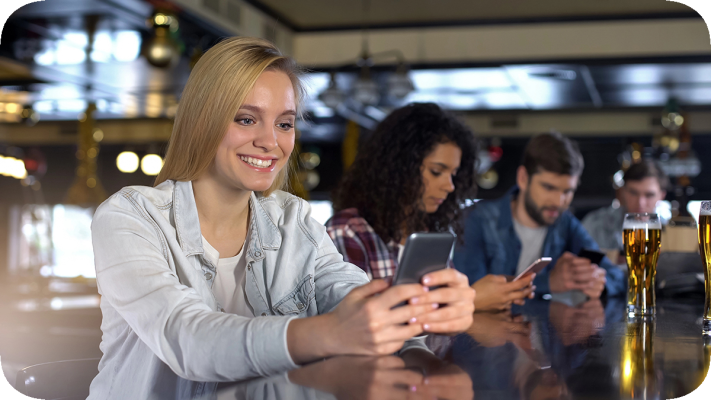
Watch any waiting area today and you’ll see the same behavior:
Phones come out almost immediately.
Customers are already looking for something to do. The question isn’t whether they’ll use their phones – it’s what they’ll use them for.
Left alone, that usually means:
Mindless scrolling
Impatience
Checking the time
Losing awareness of the venue entirely
But when that attention is guided toward something purposeful and light, the emotional experience of waiting changes.
Why This Matters More Than Ever
Modern customers have:
Shorter attention spans
Higher expectations
Less patience for uncertainty
At the same time, staff are busier than ever and can’t constantly manage expectations during peak periods.
That makes perceived wait time one of the most important – and least addressed – parts of the guest experience.
Improving how waiting feels doesn’t require faster kitchens or more staff.
It requires understanding human behavior.
The Takeaway
Waiting will always be part of bars and restaurants.
But frustration doesn’t have to be.
When customers are occupied, engaged, and mentally stimulated, waits feel shorter, fairer, and less stressful — even when nothing operational changes behind the scenes.
In the next post, we’ll explore why doing something simple and interactive is far more effective than passive distractions, and how venues can apply this without adding work for staff.
Curious how this works in a real venue?
View a live demo of SmartTableTent and see how interactive engagement fits naturally into the waiting experience.
Next up: Occupied Wait Time: Why Doing Something Makes Time Feel Shorter